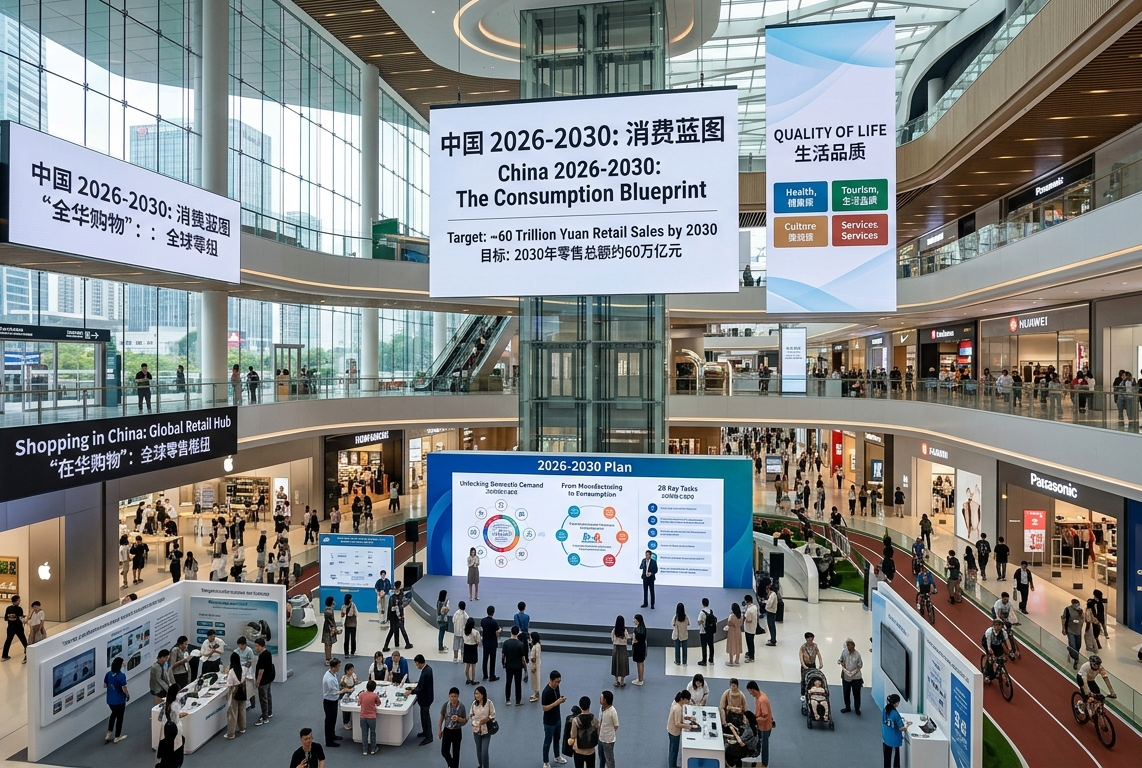
China has launched an unprecedented economic strategy for the 2026–2030 period, setting a landmark target to boost total retail sales of consumer goods to approximately 60 trillion yuan (~$8.8 trillion) by the end of the decade. This ambitious move follows a historic milestone in 2025, when retail sales crossed the 50 trillion yuan threshold for the first time, underscoring consumption's vital role in driving national economic growth.
A Historic Shift in Macroeconomic Planning
For the first time in China’s modern economic history, Beijing has drafted a standalone blueprint dedicated entirely to expanding domestic consumption. Previously, consumer spending goals were treated as secondary priorities, tucked away inside broader five-year national development plans.
"This marks a breakthrough in top-level economic design. The plan reflects Beijing’s clear intent to place consumer demand at the absolute center of its long-term growth strategy."
— Fu Yifu, Researcher at Jiangsu Su Merchants Bank
While consumption accounted for 52% of China’s GDP growth in 2025, structural bottlenecks—such as high household savings rates and an economy traditionally driven by heavy investment—have kept its full potential from being realized.
The Roadmap: 28 Tasks Across 6 Key Areas
To pivot away from an investment-heavy model and unleash consumer power, the government’s new policy outlines 28 core tasks categorized into six major areas. The strategy focuses on two main fronts:
1. Boosting Purchasing Power
Income Growth: Stabilizing employment, increasing minimum wages, and opening new channels for property-based income.
Reducing Precautionary Savings: Expanding public funding for healthcare, education, and elderly care to give households the financial confidence to spend rather than save.
2. Elevating Quality of Life & Service Consumption
The blueprint heavily targets high-value lifestyle and service sectors, aiming to shift consumer habits toward experience-based spending. Key areas of focus include:
Elderly and childcare services
Culture, sports, and recreation
Health wellness and tourism
Case in Point: The Rise of Experience-Based Travel
This structural shift is already visible. In 2025, China's domestic tourism sector surged by 9.9%—more than double the global average—fueled by a younger demographic seeking lifestyle experiences.
A prime example is Wanning, a coastal city in Hainan province. Once known purely as a surfing spot, Wanning has rebranded itself as a premier destination for fitness tourism, paddleboarding, and cycling.
The Result: In the first half of 2026 alone, Wanning drew over 6.3 million tourists, with the vast majority participating in active, sports-related travel.
Positioning China as a Global Shopping Hub
The blueprint also looks outward, aiming to capture international spending by modernizing the inbound tourism and retail ecosystem. Planned improvements include:
Expanding visa-free entry policies.
Increasing international flight capacities.
Streamlining tax refund systems for foreign travelers.
Launching the flagship "Shopping in China" initiative to elevate the country’s status as a premier global retail destination.
Global Implications: A $10 Trillion Opportunity
Experts agree that a self-sustaining, consumer-driven China will reshape the global economic landscape, offering massive opportunities for multinational brands.
Chi Fulin (President of the China Institute for Reform and Development) estimates that if China aligns its global consumption share with its massive manufacturing output, it could inject at least $10 trillion into the global consumer market by 2035.
Zou Jiayi (President of the Asian Infrastructure Investment Bank) points out that transitioning to a consumption-led model will foster balanced trade, strengthen import-export dynamics, and bolster global economic stability.
The Corporate Verdict
Multinational companies operating in China are already expressing renewed confidence. Executives note that the shifting priorities of Chinese consumers—who increasingly value quality, design, and unique experiences over raw price—are opening up highly lucrative avenues in the health, lifestyle, and technology sectors.
While structural wealth gaps and systemic imbalances remain to be solved, Beijing's coordinated policy push marks a decisive entry into the "full-scale construction" phase of its 15th Five-Year Plan, cementing consumption as the primary engine of its economic future.
China’s New Economic Blueprint: Placing the Consumer at the Center (2026–2030)
W
World Scope NewsJul 17, 2026 at 2:00 PM