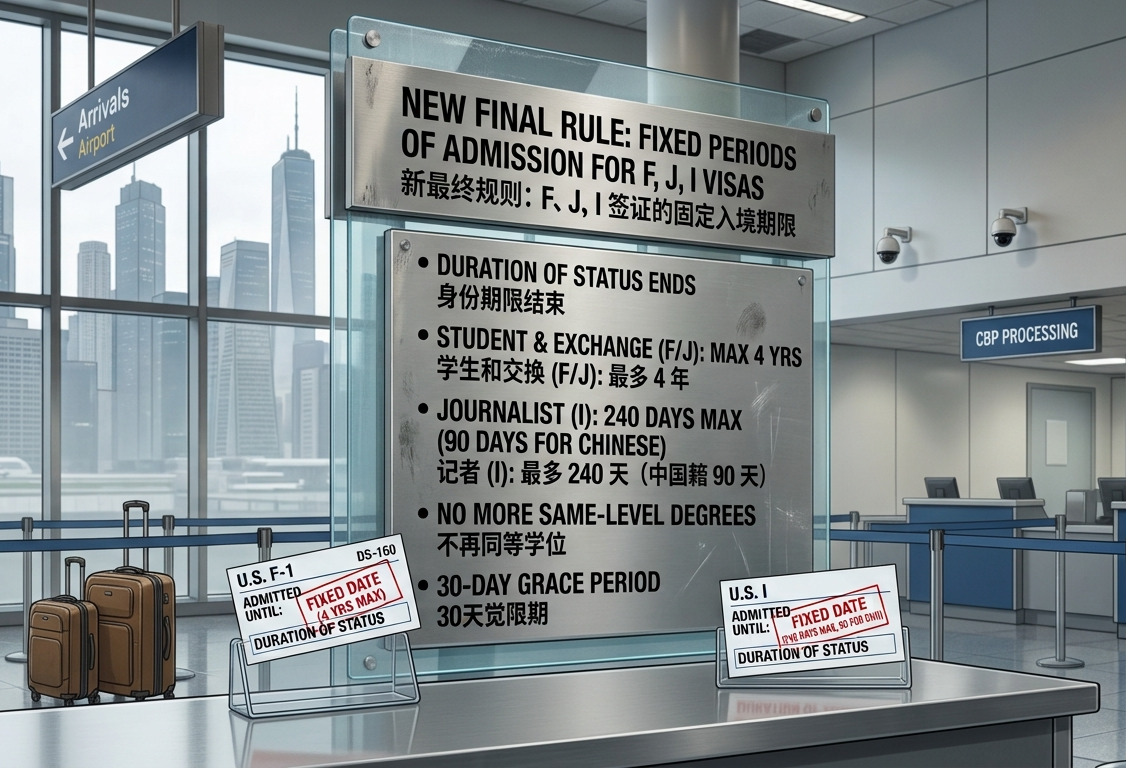
The U.S. Department of Homeland Security (DHS) has finalized a sweeping regulation that replaces the long-standing "duration of status" framework with strict, fixed periods of admission for F (international student), J (cultural exchange visitor), and I (foreign media) visa holders.
Currently, these visas allow holders to remain in the United States indefinitely, as long as they maintain active enrollment or employment. Under the newly issued final rule, that open-ended policy will end.
Key Policy Changes
The new regulations introduce several rigorous limits to nonimmigrant stays:
F and J Visas: Holders will be admitted for the duration of their specific academic or exchange program, capped at a maximum of four years.
I Visas (Foreign Journalists): Stays will be limited to a maximum of 240 days, with Chinese nationals facing a stricter cap of 90 days.
Transition for Current Visa Holders: Nonimmigrants currently in the U.S. under "duration of status" will automatically transition to the new system, with their authorized stay capped at a maximum of four years from the rule’s effective date.
Extensions: Visa holders who need to remain in the U.S. beyond their fixed limit must formally apply for an Extension of Stay (EOS) through U.S. Citizenship and Immigration Services (USCIS), which requires biometric vetting and background checks.
Tightened Academic Controls
The final rule places heavy restrictions on international student mobility and post-graduation timelines:
┌──────────────────────────────────────────────┐
│ POST-GRADUATE GRACE PERIOD │
└──────────────────────┬───────────────────────┘
│
Old Policy: 60 Days ▼ New Policy: 30 Days
[──────────────────────┼──────────────────────]
│
▼
Accrual of Unlawful Presence Begins Immediately
Shortened Grace Period: The time allowed for F-1 students to prepare for departure, transfer schools, or change their immigration status after graduation is halved from 60 days to 30 days.
No Lateral or Reverse Degrees: Students who complete a program are barred from pursuing another degree at the same or a lower academic level.
Academic Transfer and Major Restrictions: The regulation prohibits graduate students from changing their educational objectives (such as majors) or transferring to another institution altogether.
Rationales and Reactions
The administration, led by President Donald Trump—who has pursued a broad immigration crackdown since taking office in January 2025—framed the rule as a necessary national security measure. DHS pointed to a surge in visa admissions, noting that fiscal year 2024 saw over 1.8 million student visa admissions, 500,000 exchange visitors, and 37,300 foreign media members.
The department argued that the sheer volume of arrivals has overwhelmed its ability to monitor nonimmigrants, citing instances of individuals remaining in the U.S. for decades under the guise of being "forever students".
"For nearly half a century, the outdated 'duration of status' system has compromised national security and created an environment ripe for immigration fraud."
— Markwayne Mullin, DHS Secretary
Criticism from Experts and Sponsoring Institutions
The policy has drawn sharp criticism from immigration reform advocates and university officials:
Doug Rand, a former DHS official, criticized the move for adding counterproductive hurdles: "Most Americans understand the value of welcoming international students and getting rid of needless red tape. This rule would do the opposite."
David J. Bier, director of immigration studies at the Cato Institute, questioned the legal basis of the restrictions, warning that giving students only 30 days to secure employer sponsorship after graduation will abruptly force many out of the country. "Have these people no understanding of how life works?" he remarked.
International Opposition: Beijing’s foreign ministry previously criticized the proposed curbs on Chinese journalists, labeling them discriminatory.
Timeline for Implementation
The rule is classified as a "major rule" and will take effect 60 days after its publication in the Federal Register, subject to congressional review. Unless altered by Congress, the new fixed-period framework is expected to go into full effect by September 15, 2026.
Strict Limits Placed on U.S. Student, Exchange, and Media Visas Under New DHS Rule
W
World Scope NewsJul 16, 2026 at 2:05 PM